Evaporative coolers versus reverse-cycle air conditioning
One machine opens the house and adds moisture. The other seals it and wrings moisture out. Climate, smoke, water and winter decide which one you actually want.
Published 22 October 2024
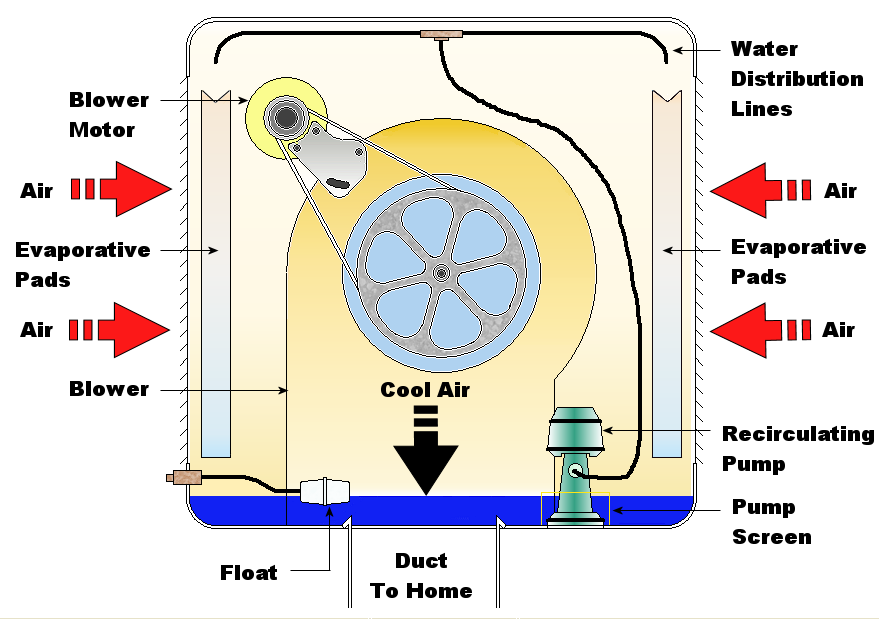
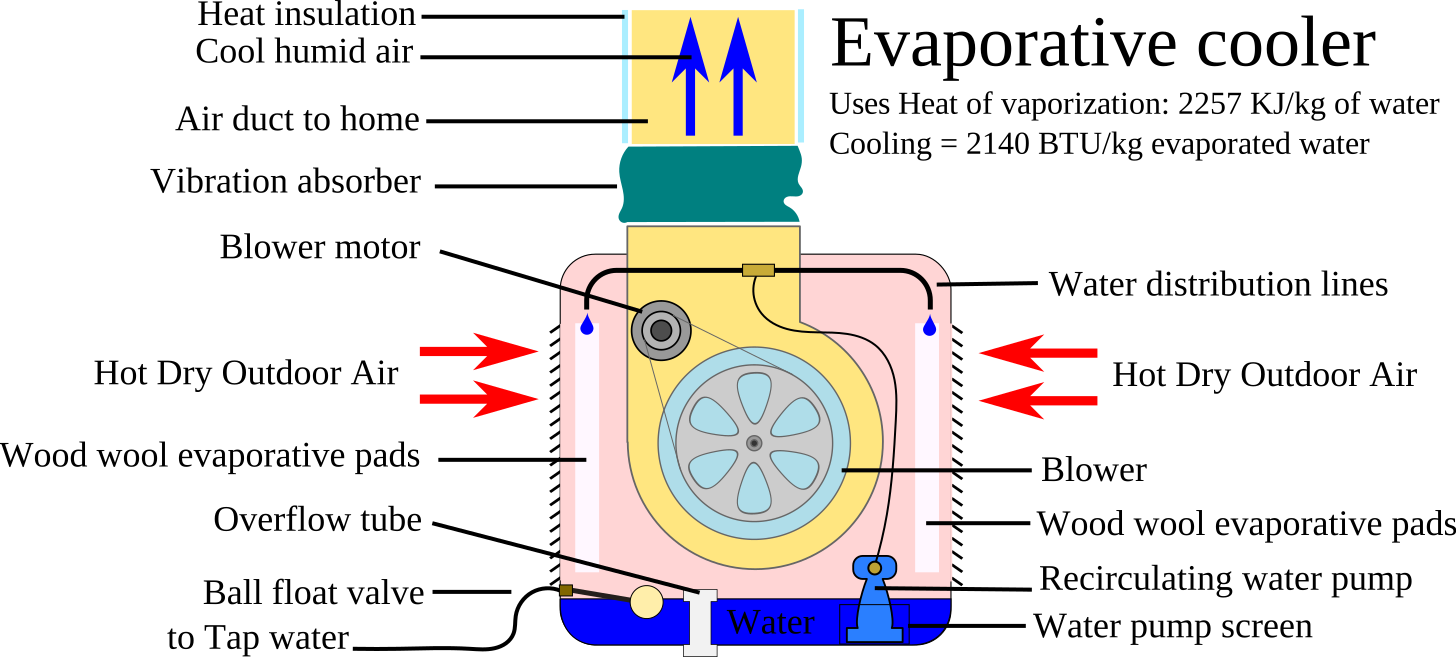
Two common machines sit on Australian houses and are asked to do the same colloquial job: make summer bearable. They do not do the same job. An evaporative cooler takes outdoor air, wets it, and pushes it through the building so that air can leave again. A reverse-cycle air conditioner recirculates indoor air over a cold coil, dumps heat outside, and works best when the building is shut.
People compare them as if they were two sizes of the same appliance. They are two theories of a house. One theory says the house is a lung. The other says the house is an esky. Both can be right. They are rarely right on the same afternoon in the same postcode.
Sealed rooms versus an open house
Reverse-cycle cooling assumes a boundary. Insulation, closed windows, door snakes, maybe even a bit of weatherstripping the previous owner painted over. The compressor is moving heat from inside to outside. Every time you open a sliding door onto a forty-degree patio you are inviting that heat back in and making the machine repeat itself. The manual is not being precious. The physics is.
Evaporative cooling assumes the opposite. The unit on the roof is an intake. If the moist, cooled air cannot leave, humidity rises and the pad’s ability to evaporate falls away. Windows have to stay open. So do enough doors to give the air a path from the rooms you are using to the leeward side of the house. A ducted evaporative system in a tightly sealed, newly built box-with-a-HRV is a category error.
This is why a household can love evaporative cooling in a 1970s brick veneer with aluminium sliding windows and hate it in a renovated terrace that has been “done” into a reverse-cycle envelope. The machine did not change. The house’s job description did.
There is a hybrid life that many Australian families already live without naming it: evaporative through the living areas on a dry Saturday, a bedroom split for the humid night or the week a north-easterly arrives. That is not indecision. That is matching the tool to the room.
Humidity is not a side-effect. It is the mechanism.
Evaporative cooling humidifies. That is how the temperature drop is bought. Reverse-cycle cooling dehumidifies, because water condenses on the cold coil and is drained away. If you have ever emptied a split-system drain or seen the puddle under an old window box, you have watched that moisture leave the room.
On a dry inland day the extra moisture from an evaporative cooler is often a comfort. Skin and sinuses that felt like paper in a Merredin afternoon sit easier. On a humid day the same moisture is the complaint. The room does not feel cool. It feels occupied by weather.
Reverse cycle can make a sealed room feel cool and dry even when the outdoor wet-bulb is hopeless for evaporation. It can also make a room feel dead: the same air, recirculated, a little too cold, a little too dry, with the outdoor world treated as an enemy. Some people prefer that. People with particular respiratory issues sometimes do, and sometimes do not; this journal will not diagnose from a grille. What it will say is that the two machines leave different water in the air, and your body notices.
Heating is not a tie-breaker. It is a forfeit.
A rooftop evaporative cooler does not heat. In July it is a hole unless you cover it and close the ceiling vents. Reverse-cycle air conditioning is a heat pump. In much of southern Australia it is the winter heater as well as the summer cooler, which is why the comparison that only looks at January electricity is a half-argument.
If your house needs winter heating — Melbourne’s west, the Adelaide Hills, inland New South Wales nights — reverse cycle is already in the building for a reason evaporative cooling cannot touch. You might still want evaporative for the dry heat of February. You should not pretend the evaporative unit is a year-round climate system. A gas heater or a wood stove plus an evaporative cooler can be a coherent dry-climate kit. It is a different household to the apartment that needs one wall unit to do everything.
Power is the part evaporative usually wins
A ducted evaporative cooler is a fan and a small water pump. A reverse-cycle system is a compressor, fans, and electronics, sized to move heat against a gradient. In dry weather the evaporative unit’s electricity use is the cheap part of the story, which is why older marketing still talks as if running cost were settled.
It is not settled, because water is a running cost, and because reverse-cycle units have become far more efficient than the rattling boxes of the 1990s. A modern split in a sealed room can be frugal in kilowatt-hours while still being the right machine for humidity. Compare the actual kit, not the category slogan.
Still: if the question is “what draws less power on a dry 38-degree afternoon to keep a whole house tolerable”, evaporative cooling has a structural advantage. It is not fighting the outdoor air. It is using it.
Water is the part evaporative can lose
NSW Planning has described evaporative use in a range of about 10 to 30 litres an hour, depending on size and humidity. Water Corporation in Perth has talked about around 100 litres an hour evaporating in hot weather, and about 30,000 litres a year at six hours a day for fifty days. CHOICE, citing a 2009 study, put Hobart-type conditions in a 41 to 70 litre-an-hour band and Adelaide in 67 to 116. Bleed-off on older systems often adds 11 to 20 litres an hour; newer dump control can be around 3. A bucket half full in thirty minutes is, in Water Corporation’s picture, about 11 litres an hour of bleed.
Reverse cycle uses water only in the trivial sense of condensate to a drain. Its expensive fluid is electricity, and sometimes the gas it displaced.
In a city with dear water, restrictions, or a household already staring at a thirsty garden, the evaporative “cheap to run” line needs both meters on the table. In a town where water is less politically loud than the peak tariff, the fan still looks like a bargain. Perth is not Launceston. Perth’s dry heat is also why the rooftop cooler never left the skyline.
Smoke days, pollen, and outdoor air you do not want
Evaporative coolers are outdoor-air machines. When the sky is brown, they pull that sky through a wet pad and into the hallway. The pad is not a gas mask. Public guidance and ordinary sense agree: switch them off in bushfire smoke, close up, and use whatever recirculating, filtered cooling you have — which, in many houses, means reverse cycle or nothing.
Pollen, dust storms and a neighbour’s burn-off are milder versions of the same problem. Reverse cycle at least lets you choose not to import the afternoon. If summers now include smoke weeks, that belongs in the buying decision. An evaporative-only house needs a fallback. The cooler on the roof cannot be that plan.
When evaporative cooling wins
It wins in hot, dry climates with a housing stock that already leaks a little air: Perth, Adelaide, inland Victoria, the New South Wales slopes and west, western Queensland. It wins in houses where people live in the whole building in daytime, not in one sealed bedroom. It wins in workshops, churches, and sheds where a refrigerated plant would be enormous and a flush of cooler outdoor air is the point. It wins when the household will actually open windows and service pads.
It wins on electricity in those climates. Quotes against fully ducted reverse cycle vary; this journal does not run a price list. Bonaire, Braemar from Seeley International, and Climate Technologies are names you will keep meeting on Australian roofs. They are market context, not a ranking.
When reverse cycle wins
It wins on humid coasts — Sydney, Brisbane, Cairns, Darwin’s wet season — where the wet-bulb refuses to help. It wins at night when you want a sealed, dark, quiet bedroom and the outdoor air is still warm and moist. It wins in apartments that cannot dump air into a neighbour’s courtyard. It wins when winter heat is required from the same wall box. It wins in smoke. It wins for anyone who will not, or cannot, live with open windows: security, traffic noise, a sleeping shift worker, a street that does not feel safe with the front rooms open to the night.
It also wins, increasingly, in new houses built to be tight. Those buildings were designed around refrigerated air and controlled ventilation. Bolting a 1998 evaporative habit onto them is a fight with the architect.
The useful question is not which machine is “better”. It is which afternoon you are buying for, and whether you are willing to own two strategies. Plenty of Australian houses already do: a ducted evaporative unit for the dry months, a split in the rooms that have to work when the weather turns humid or brown. That is not failure to choose. That is refusing to let a brochure choose for you.
Frequently asked
- Can I run evaporative cooling and reverse cycle at the same time?
- Not as a single strategy in the same space. The evaporative unit wants windows open and is adding humidity. The reverse-cycle unit wants a sealed room and is trying to dry and recirculate. Running both is how you pay for two meters and get the worse of each machine.
- Is evaporative cooling cheaper than reverse cycle?
- Electricity usually is. A rooftop evaporative fan and pump draw a fraction of a compressor. Water may not be cheaper, especially on a hard Perth afternoon or with bleed-off set like a leaking tap. Winter heating is not in the evaporative column at all.
- Which system is better during a heatwave in Sydney?
- Humid heatwaves on the New South Wales coast are a poor match for evaporative cooling. Reverse cycle, or at least a sealed bedroom with a split, is the tool for that weather. The same week in Kalgoorlie or Merredin is a different argument.
More from How it works
How it works · 18 November 2024
Why evaporative coolers need open windows
The cooler is an intake. Windows are the exhaust. Close them and you have built a humidifier with a loud fan and no way for the moisture to leave.
How it works · 5 November 2024
Direct versus indirect evaporative cooling
Direct systems wet the air you live in. Indirect and two-stage machines keep moisture out of the supply stream and chase a lower limit, at a price most Australian houses still will not pay.
How it works · 8 October 2024
How evaporative cooling works in an Australian house
A ducted evaporative cooler is a wet-pad weather machine: outdoor air, latent heat, a rooftop fan, and an open house that has to let the moisture leave.