Direct versus indirect evaporative cooling
Direct systems wet the air you live in. Indirect and two-stage machines keep moisture out of the supply stream and chase a lower limit, at a price most Australian houses still will not pay.
Published 5 November 2024
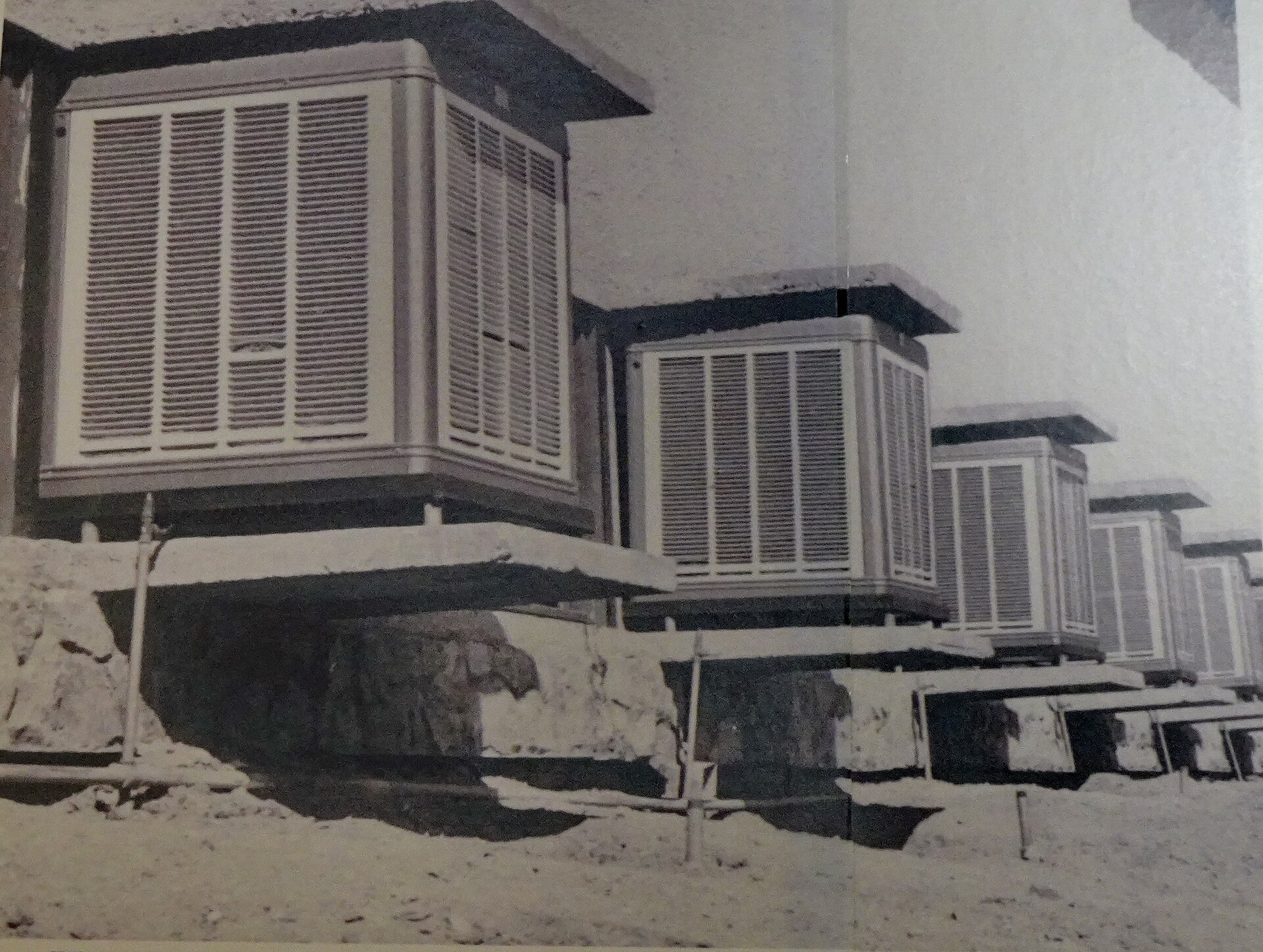
Almost every evaporative cooler on an Australian house is a direct machine. Outdoor air touches water. The air is cooled and humidified in the same pass, then sent into the rooms. That is the technology the suburbs mean when they say “the evap”.
Indirect and two-stage systems exist. They are not science fiction, and they are not a secret the retailers have been hiding in the back room. They are heavier, wetter in the plant room, and aimed at a different limit than a cellulose pad on a Colorbond roof. Understanding the difference is useful even if you never buy the complicated version, because it explains why the simple version still dominates, and where its ceiling really is.
Direct cooling, which is the Australian default
In a direct evaporative cooler, the air you will breathe is the air that evaporates the water. Pads, a sump, a pump, a fan. Temperature down, moisture up, heading toward the outdoor wet-bulb. The house must exhaust that air. This journal has walked through that physics already; the point here is the word direct. Contact is the point.
Direct systems are efficient in the electrical sense because they are mostly a fan. They are also honest about humidity. You cannot have the temperature drop without taking on vapour. If the outdoor air is dry enough, that bargain is excellent. If it is not, you are installing a swamp.
The rooftop units sold under familiar Australian names — Bonaire, Braemar from Seeley International, Climate Technologies among them — are, in household form, direct machines. They are sized for whole-house airflow, sat on stands, tied into ceiling ducts, and asked to run for a generation with periodic pad changes. The market did not arrive there by accident. It arrived there because Perth and Adelaide summers, and the dry inland, reward exactly this bargain.
Indirect cooling: evaporation next door
An indirect evaporative cooler still evaporates water. It does not evaporate it into the air that is going to the lounge. A secondary airstream is wetted and cooled. That cold, wet stream is then used as a heat sink, usually through a heat exchanger, to cool a primary (product) airstream that never touches the water.
The product air comes out cooler and not much wetter than it went in. Indoor humidity does not climb the way it does with a direct unit. Windows can, in principle, be managed more like a refrigerated system, though you still need a coherent ventilation story. The cooling is still bounded by evaporation: the secondary air cannot get below its own wet-bulb, and the heat exchanger is not perfect, so the product air does not reach some magical refrigerated setpoint.
What you have bought is a way to use evaporative physics without turning the living room into a greenhouse. What you have also bought is more plant: two air paths, a heat exchanger that must stay clean, more water handling, more points of failure, more roof or plant-room bulk.
Indirect units make more sense where adding humidity is unacceptable — some commercial interiors, some processes, some museums and laboratories — or where the building is meant to stay closed. They make less sense as a drop-in replacement for a suburban rooftop box whose owners already live with open windows and a wet-bulb that cooperates.

Two-stage machines and the dew-point conversation
A two-stage evaporative cooler typically runs an indirect stage first, then a direct stage. The product air is pre-cooled without being wetted, so it arrives at the direct pads drier and cooler than outdoor air. The direct stage can then evaporate more effectively than it could on raw outdoor air. The result can be a lower supply temperature than a single direct pass, with a humidity rise that is less brutal than a direct-only unit trying to do all the work.
There are further cycle designs, often discussed under dew-point or Maisotsenko-style names, that aim to push product air toward the dew point rather than stopping at the wet-bulb of the outdoor air. Dew point is lower than wet-bulb. If you can approach it, you have a cooler supply stream without a compressor. You also have a machine that looks less like a household appliance and more like a piece of air-handling equipment with a manual.
This journal will not pretend those cycles are on every Bunnings aisle. They are not. They matter because they describe the real thermodynamic ceiling. Direct household units live under the wet-bulb. Indirect and multi-stage plants can, depending on design, work a bit closer to the dew point. Reverse-cycle plants leave that conversation entirely and go to a cold coil.
If someone sells you “below wet-bulb” as a household rooftop upgrade without explaining stages, secondary air, water rate and maintenance, ask for the diagram. Latent heat is not a marketing flavour.
Why the Australian house still wears a direct unit
Three practical reasons, and a fourth that is cultural only in the sense that culture is just accumulated invoices.
First, climate. The places where evaporative cooling is still a default — Perth, Adelaide, inland Victoria, the New South Wales slopes and west, western Queensland — have long stretches where the wet-bulb is low enough that a direct unit does the job. You do not buy a two-stage plant to solve a problem the single-stage plant already solves on a January afternoon in Northam.
Second, housing. The Australian evaporative house is an open house. Direct cooling wants exhaust air. The windows are already part of the kit. Indirect’s humidity advantage is worth less if you were never trying to seal the building. Compare that with a European or North American tight building, or a coastal apartment, where adding moisture is a mould story and a comfort story at once.
Third, cost and bulk. A ducted direct rooftop unit is a known object for installers: water point, drain, stand, ducts, controller. Indirect and two-stage systems cost more, weigh more, and ask more of the roof and the plumber. Household buyers in this country have historically taken the simpler machine and spent the leftover money on pad changes and a winter cover.
Fourth, the comparison that actually keeps people up at night is not direct versus indirect. It is evaporative versus reverse-cycle. Once a household is in the evaporative column at all, the direct rooftop unit is the product that exists in the supply chain, the spare-parts book, and the neighbour’s roof.
Commercial kitchens, data halls, warehouses and some schools are where you are more likely to find indirect stages, or evaporative pre-cooling in front of a mechanical plant. That is a different buying process, with engineers and a maintenance contract, not a colour brochure on a fridge magnet.
Limits that do not care what you named the cabinet
Direct, indirect, or two-stage, you are still evaporating water. Outdoor humidity still governs how much temperature you can harvest. Water still appears on the bill. Bleed-off still exists if you do not want the heat exchanger or the pads to fur up. Smoke still should not be pulled through the building. A humid coast is still a bad client.
Indirect does not make Sydney into Kalgoorlie. It makes a dry climate more usable in a sealed or humidity-sensitive space. Two-stage does not abolish the need for water. It spends more plant complexity to wring extra cooling out of the same atmosphere.
There is a temptation, especially in online arguments, to treat indirect cooling as the grown-up version and direct as the primitive one. Direct is primitive in the way a water tank is primitive. It is also well matched to a large part of the Australian map. The grown-up move is to know which limit you are against — wet-bulb, dew point, or the compressor — and to stop asking a pad to impersonate a reverse-cycle coil.
Most houses here will keep buying the direct rooftop unit until the climate, the building code, or the price of water makes that choice look foolish. Watch those three. The thermodynamics have been on the public record for a long time.
Frequently asked
- Is indirect evaporative cooling the same as air conditioning?
- No. Indirect evaporative cooling still uses evaporation as the heat sink. It just keeps the evaporated moisture in a secondary airstream so the air delivered to the room is cooler without being wetted. There is still no compressor doing the thermodynamic heavy lifting of a reverse-cycle coil.
- Why don't Australian houses use two-stage evaporative coolers?
- Cost, bulk, water plumbing, and a climate that already makes simple direct units good enough in Perth, Adelaide and the dry inland. Two-stage and indirect machines show up more in commercial and industrial work than on ordinary suburban roofs.
- Can indirect cooling go below the wet-bulb temperature?
- A conventional indirect stage is still governed by the wet-bulb of the air that is doing the evaporating. Some two-stage and dew-point cycle designs can pull product air toward the dew point, which is lower than the wet-bulb. That is a different, dearer machine than the rooftop unit most households own.
More from How it works
How it works · 18 November 2024
Why evaporative coolers need open windows
The cooler is an intake. Windows are the exhaust. Close them and you have built a humidifier with a loud fan and no way for the moisture to leave.
How it works · 22 October 2024
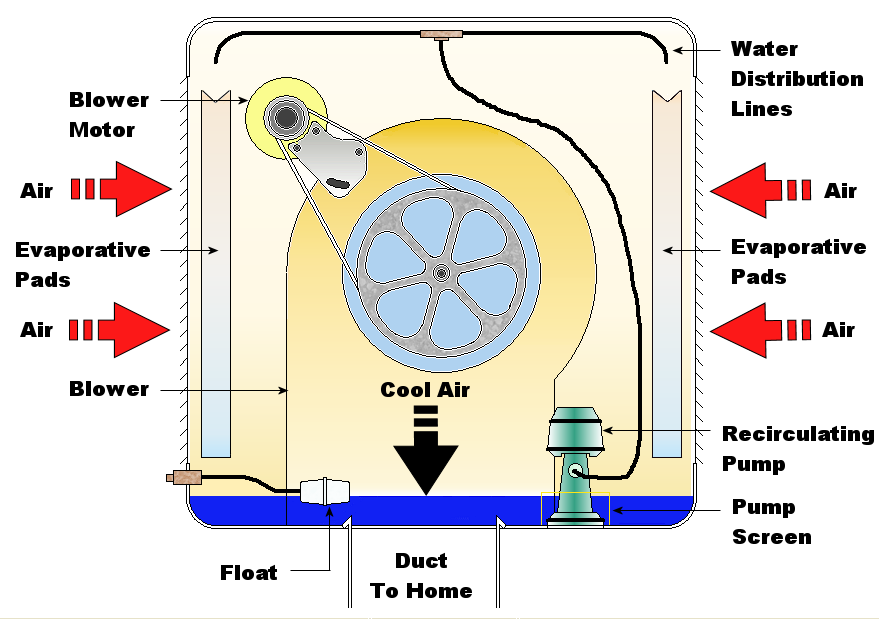
Evaporative coolers versus reverse-cycle air conditioning
One machine opens the house and adds moisture. The other seals it and wrings moisture out. Climate, smoke, water and winter decide which one you actually want.
How it works · 8 October 2024
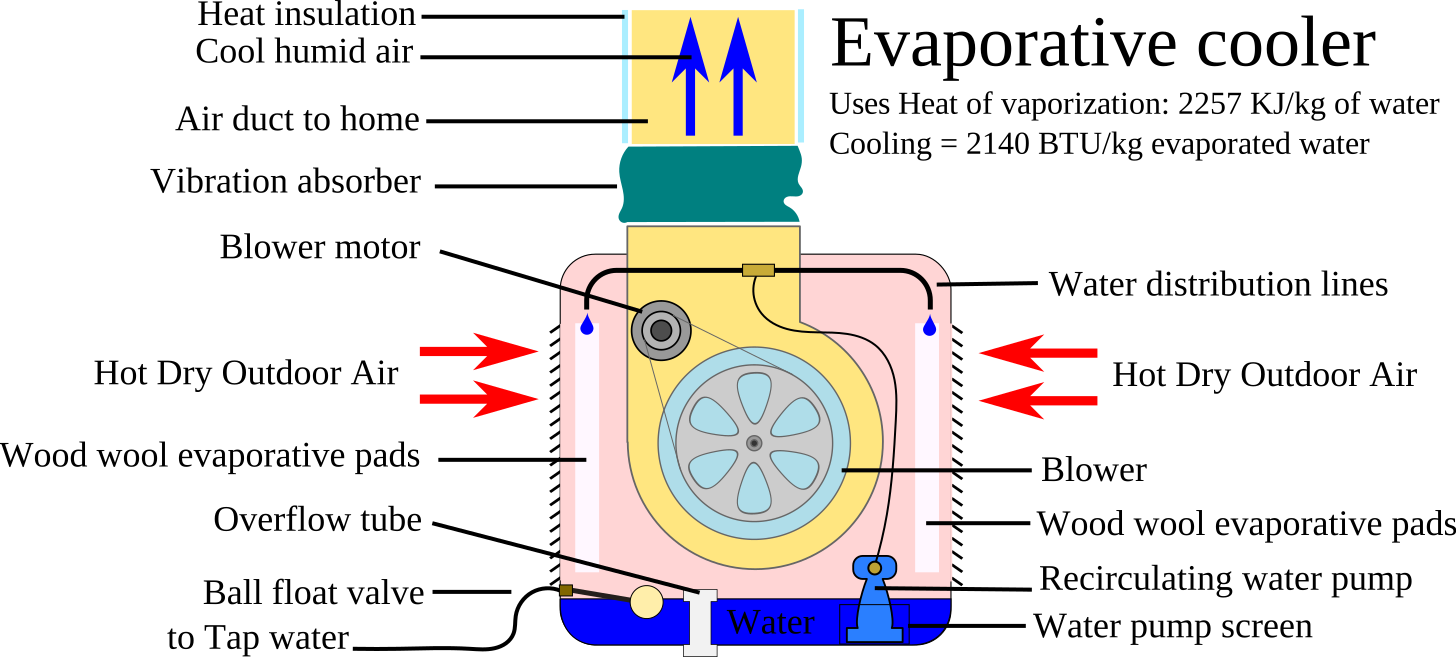
How evaporative cooling works in an Australian house
A ducted evaporative cooler is a wet-pad weather machine: outdoor air, latent heat, a rooftop fan, and an open house that has to let the moisture leave.