Evaporative cooling in Adelaide and regional South Australia
Adelaide’s dry heat still suits a wet pad on the plains. Hills weather, a 2009 water study and a long memory of restrictions decide how hard the rooftop unit should work.
Published 31 March 2025 · Updated 3 February 2026
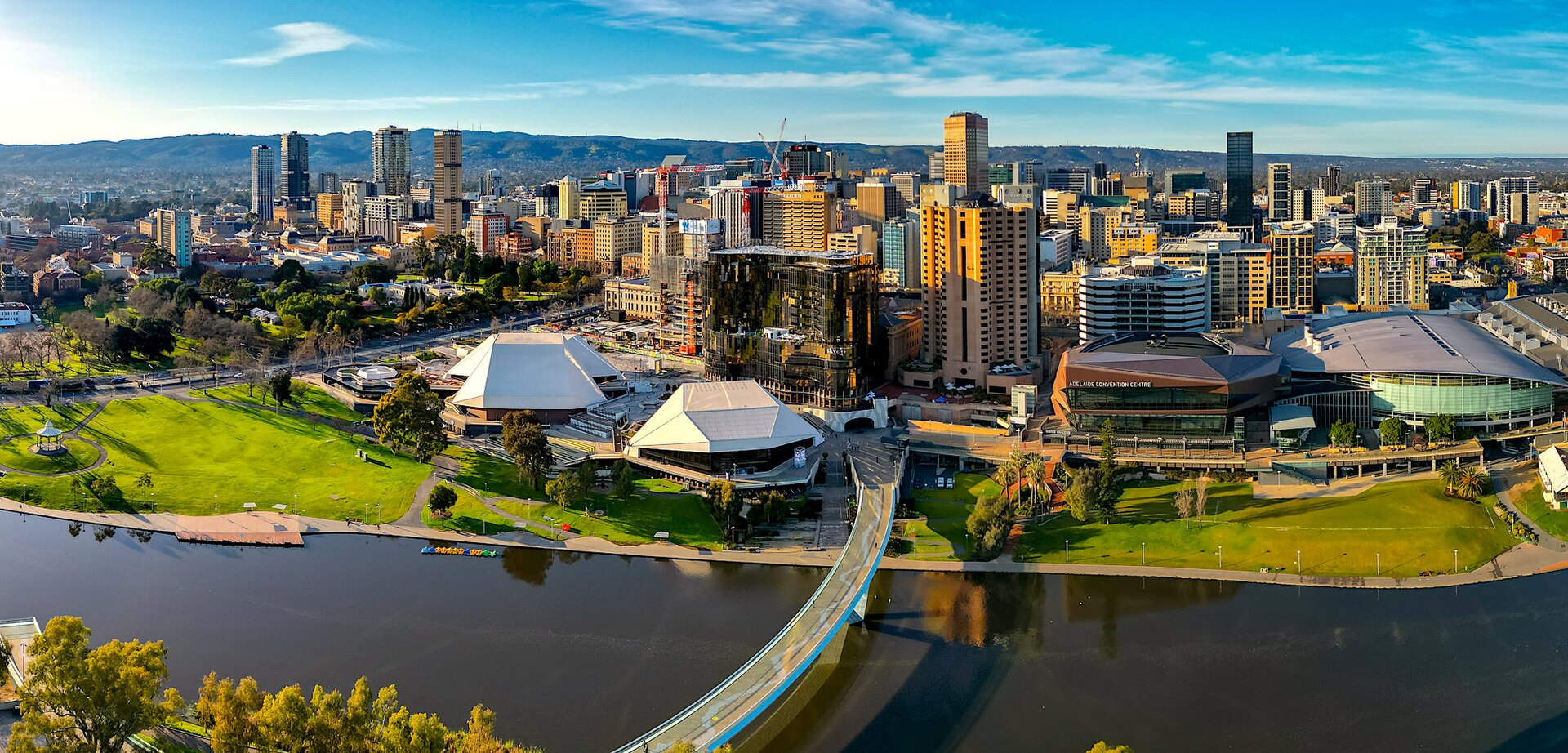
Adelaide is evaporative country with a long memory. The plains still see dry, brutal heat on a northerly. The hills catch a different afternoon. The city went through water restrictions that turned every outdoor tap into a political object, and rooftop coolers were part of that argument. None of that erased the wet-bulb gap on a 44 °C January day in the northern suburbs. It did mean a unit that leaks or bleeds like a garden hose will not get a free pass.
The national bands are in where evaporative cooling works. This is the South Australian case: plains versus hills, a public water figure that is actually about Adelaide, and the towns beyond the ranges that never really stopped using pads.
Dry heat on the plains
The Adelaide plains — from the coast through the inner north and out toward Gawler and the Barossa’s lower edge — can produce the textbook evaporative afternoon: high dry-bulb, low humidity, a hot wind off the inland. On those days a serviced rooftop unit, windows open, will drop a house in a way that still surprises people who have only known reverse-cycle.
The morning can already be hard. The change, when it comes, is often a cooler south-westerly with more moisture. As in Perth, the late afternoon can close the gap. Running the pump into a moist change makes the hallway feel like washing. Fan-only, or off, is the honest setting until the air dries again.
Housing stock matters. Double brick that opens, a shaded west wall, and ceiling insulation will spend the climate well. A sealed renovation with tinted windows that never open will not, and no pad area will fix that. Evaporative cooling in Adelaide is still a ventilation practice. The heatwave does not care that you added downlights.
Hills, valleys and the sea breeze
The Adelaide Hills are not the plains with a view. Elevation knocks the maximum back. Vegetation and valley air raise humidity. A south-westerly that is a relief on the coast can be a moist change in a gully. Stirling is not Pooraka. Aldgate is not Two Wells.
A unit already on a hills house is worth running on the dry, hot days — they do happen, especially on a north to north-east wind. Installing a new ducted system as the only summer plant is a finer judgement. Many hills houses now mix a split in the bedrooms with open windows and a fan in the living rooms. That is not a failure of nerve. It is reading the ridge.
Coastal western suburbs feel the gulf breeze earlier. The far north and the near north, sitting further from the water and closer to the inland, stay in the dry column longer. If you are comparing quotes across “Adelaide”, say which Adelaide. The installer who treats them as one climate will size you for a house they have not stood in at 3 pm.
What the 2009 water figures actually said
CHOICE has pointed to a 2009 study with numbers people still argue about: 67–116 litres per hour in Adelaide, 41–70 in Hobart. Those ranges are useful because they are about named cities, not a national blur. Adelaide’s higher band matches a hotter, drier cooling season. Hobart’s lower band matches a milder, moister one.
They are not your bill. A tight, well-bled modern unit on a mild week will sit low. A tired pad bank with the dump valve open on a northerly fortnight will sit high, or past the top. NSW Planning’s 10–30 litres per hour is another public range, and it reads like a more humid, more modest use. Water Corporation’s Perth picture — around 100 litres per hour in hot weather, about 30,000 litres a year at six hours a day for 50 days — sits in the same conversation: dry-city litres, not a coastal trickle.
Read the three together and you get a shape, not a promise. Adelaide in a heatwave looks more like the top of that 2009 range and like Perth’s hot-day figure than like Hobart. Electricity remains the cheap line. Water is the one that needs a meter and a bleed you can describe.
The 2009 study also quietly tells you that location is a water specification. Moving the same cabinet from Adelaide to Hobart changes the litres without anyone touching a valve. Climate is a consumption setting.
Restrictions memory
South Australians who lived through the drought-era rules do not need a lecture about outdoor water. Coolers were discussed in the same breath as fountains and midday sprinklers. Some households took units off roofs and never put them back. Some fitted timers, tighter bleeds and covers, and kept the plant.
The lesson that travelled is notice, not abstinence. A cooler that evaporates into dry air is doing its job. A cooler that fills a ceiling or runs all night on a 24 °C January is not. Current and future restriction rules will keep changing; the household habit that survives them is a visible isolator, a bleed you can catch in a bucket, and a winter shut-down that actually happens.
Rainwater tanks around the hills and the plains are common enough that people ask whether the cooler can run off the tank. It can, if the tank is sized for it and you accept that a hot fortnight will empty a small one. It does not make the litres disappear. It moves them.
Regional South Australia
Beyond the metropolitan basin the case is often simpler. The mid north, the Riverland, the Murray Mallee, the west coast towns and the far north have the dry-heat pattern that pads were built for. Houses, pubs, motels and sheds still run them because refrigerated tonnes are expensive to buy and to power, and because the wet-bulb allows the cheaper machine to work.
Hard water and dust are the regional tax. Pads cake. Distributors block. A quarterly look in season is not fussiness. Port Augusta is not a showroom climate. Neither is Renmark in a heatwave with a north wind and orchard dust.
Spot-cool a workshop if the whole shed is hopeless; wash a house if the windows open. Do not run wet pads into bushfire smoke. The state’s fire days are not theoretical, and an evaporative unit is a deliberate hole to the outdoors.
Winter still exists, even on the plains. Fit the cover, close the ceiling vents, and let the pads dry. An open cabinet through a wet July collects leaves and a smell that will be waiting in November. The first useful northerly is the time to wet the pads again, not the first warm week in September when the air is still mild and you are only buying litres.
Adelaide will keep arguing about rooftop coolers because it is a dry city with a wet memory and a hill line that lies about the plains. On the right afternoon the argument is settled by walking into a house that still knows how to open. The unit on the roof is only doing what the northerly allowed.
Frequently asked
- How much water does an evaporative cooler use in Adelaide?
- CHOICE, citing a 2009 study, put Adelaide use at 67–116 litres per hour. That is a measured range for that climate, not your meter. Bleed, pad condition and how long you run on a northerly will move you through the range. Hobart in the same study was 41–70 litres per hour.
- Does evaporative cooling work in the Adelaide Hills?
- Some days, yes; many late afternoons, less so. The hills are cooler and often moister than the northeastern plains. A unit that feels strong in Gawler can feel like a damp fan in a stringybark gully after a change. Size expectations to the ridge you live on, not to a “greater Adelaide” brochure.
- Should I take the cooler off the roof after the restriction years?
- Not if the house still opens and the climate on your street is dry heat. Restrictions taught people to notice litres, not that the physics had failed. A managed bleed, a winter cover and a meter you actually read are the lesson. A split system in a sealed box is a different house.
More from Climate

Climate · 26 May 2025
Humidity, wet-bulb temperature and fan-only mode
When outdoor air is already holding water, wet pads stop cooling and start humidifying. Kill the pump, feel the change, and wait out a storm-front afternoon.
Climate · 12 May 2025
Evaporative cooling in Queensland: dry inland versus the coast
Longreach, Roma and Toowoomba can still justify a wet-pad cooler. Brisbane, Cairns and the wet-season coast generally cannot.

Climate · 28 April 2025
Evaporative cooling in inland New South Wales
Why Dubbo, Wagga Wagga, Orange and Broken Hill still suit wet-pad cooling, and why the same machine is a poor match for Sydney humidity.